




20 Sep Technology Transforming Environmental Monitoring in Construction
Environmental monitoring has become an essential part of modern construction and land development projects. As environmental regulations become more complex and project stakeholders demand greater accountability, developers and contractors are increasingly relying on technology to improve how environmental conditions are monitored, documented, and managed.
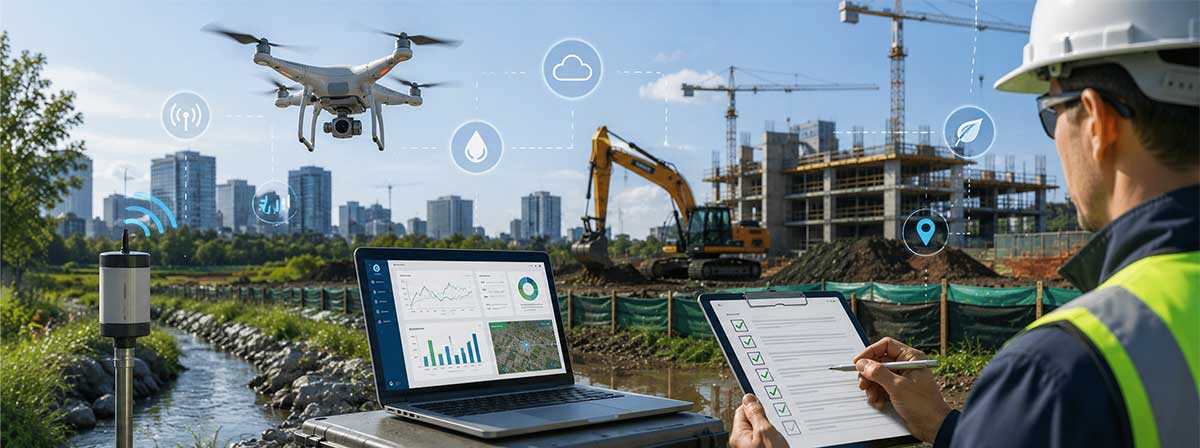
Traditional monitoring methods remain important, but technological advances are creating new opportunities to collect data faster, improve accuracy, and respond more effectively to environmental challenges. From groundwater monitoring systems to drones and digital reporting platforms, technology is helping project teams make informed decisions while supporting regulatory compliance.
As construction projects continue to evolve, these innovations are transforming the future of environmental monitoring.
The Growing Importance of Environmental Data
Construction projects generate large amounts of environmental information throughout their lifecycle. Groundwater levels, water quality, erosion control performance, weather conditions, and stormwater management systems all require ongoing monitoring and documentation.
Historically, much of this information was collected manually through site visits, field notes, and periodic inspections.
While these methods remain valuable, modern technologies now provide access to real-time data and automated reporting capabilities. This allows environmental professionals to identify potential issues more quickly and respond before problems escalate.
Better information leads to better decision-making and improved project outcomes.
Remote Groundwater Monitoring Systems
One of the most significant advances in environmental monitoring is the use of remote groundwater monitoring technology.
Modern monitoring wells can be equipped with sensors that continuously measure groundwater levels and transmit data automatically. This reduces the need for frequent manual readings while providing a more complete understanding of changing site conditions.
Real-time groundwater information can help project teams evaluate dewatering activities, monitor seasonal fluctuations, and identify unusual changes that may require investigation.
Access to continuous data improves both environmental oversight and construction planning.
Drones Are Expanding Site Visibility
Unmanned aerial vehicles, commonly known as drones, are becoming increasingly valuable tools on construction sites.
Drones allow environmental professionals to quickly assess large areas that may be difficult or time-consuming to inspect on foot. High-resolution aerial imagery can document erosion concerns, sediment movement, drainage conditions, vegetation establishment, and site changes over time.
Aerial surveys also provide visual records that can support environmental reporting and project documentation.
By improving site visibility, drones help project teams identify issues earlier and monitor environmental performance more effectively.
Geographic Information Systems Improve Analysis
Geographic Information Systems (GIS) have become powerful tools for environmental planning and monitoring.
GIS technology allows environmental data to be mapped, analysed, and visualised within a geographic framework. Information such as groundwater monitoring locations, stormwater infrastructure, environmentally sensitive features, and construction activities can be integrated into a single platform.
This approach provides a clearer understanding of site conditions and environmental relationships.
GIS technology also improves communication between project stakeholders by presenting complex environmental information in an accessible format.
Real-Time Weather Monitoring and Forecasting
Weather conditions play a major role in environmental performance on construction sites.
Heavy rainfall, strong winds, extreme temperatures, and snowmelt events can all affect erosion control systems, groundwater conditions, and stormwater management infrastructure.
Modern weather monitoring tools provide detailed forecasts and site-specific weather data that help project teams prepare for changing conditions.
Early warnings allow contractors to reinforce environmental controls, adjust schedules, and implement protective measures before severe weather occurs.
This proactive approach reduces risk and improves environmental protection.
Digital Inspection and Reporting Platforms
Environmental inspections are a critical component of compliance management. Traditionally, inspection records were maintained using paper forms and manual filing systems.
Today, many organisations use digital inspection platforms that streamline data collection and reporting.
Field personnel can record observations using tablets or mobile devices, upload photographs, track corrective actions, and generate reports directly from the field. Information becomes available immediately to project managers and environmental consultants.
Digital systems improve efficiency, reduce administrative burdens, and help maintain accurate environmental records.
Automated Water Quality Monitoring
Water quality monitoring is often required for projects involving groundwater management, dewatering activities, or discharges to receiving systems.
Advanced monitoring equipment can now measure parameters such as turbidity, pH, temperature, conductivity, and dissolved oxygen automatically.
Continuous monitoring provides more detailed information than periodic sampling alone and can quickly identify changes that require attention.
This technology supports more effective environmental management while helping projects meet regulatory requirements.
Artificial Intelligence and Predictive Analysis
Artificial intelligence is beginning to play a greater role in environmental monitoring and risk management.
By analysing large volumes of environmental data, AI-powered systems can identify patterns, detect anomalies, and predict potential issues before they occur.
For example, predictive models may help forecast erosion risks, evaluate groundwater trends, or identify areas that require additional monitoring.
Although these technologies continue to evolve, they offer exciting opportunities for improving environmental decision-making in the future.
Supporting Compliance Through Innovation
Environmental regulations continue to demand greater transparency, documentation, and accountability from construction projects.
Technology helps organisations meet these expectations by improving the quality, accessibility, and reliability of environmental information.
Whether through automated monitoring systems, digital reporting tools, drones, or GIS mapping, technology supports stronger environmental compliance programmes while reducing administrative challenges.
Projects that embrace innovation are often better equipped to manage risk and adapt to changing environmental requirements.
The Future of Environmental Monitoring
Technology is reshaping how environmental monitoring is conducted across the construction industry. As monitoring tools become more sophisticated, project teams gain access to better information, faster response times, and improved environmental oversight.
The combination of groundwater monitoring, remote sensing, digital reporting, and predictive analytics is helping create safer, more efficient, and more sustainable construction projects.
Partnering With Environmental Professionals
While technology provides valuable tools, successful environmental management still depends on experienced professionals who can interpret data, assess risks, and develop practical solutions.
Groundwater Environmental Management Services (GEMS) combines environmental expertise with modern monitoring technologies to support construction and development projects throughout Ontario. From groundwater monitoring and environmental inspections to erosion and sediment control oversight and compliance support, GEMS helps clients navigate environmental challenges with confidence.
To learn how GEMS can support your next project through innovative environmental monitoring solutions, contact the team today and discover the benefits of combining technology with environmental expertise.